Byers sits at 5,210 feet in a cold semi-arid climate, and that one line tells a grading contractor about moisture, wind and the months in which compaction works. East of Aurora the ground is open, the wind is steady and the soil dries quickly. That is good news for production and bad news for dust control and moisture conditioning, and our grading plans address both.
Mass grading is where an industrial project takes shape. The pad elevation sets the dock height, the slope of the truck court, the depth of the detention basin and the gravity run of the underground lines. We treat the grading plan as the master drawing for the site and review it with the building designer before the first scraper starts, because the cost of moving a pad one foot is far lower on paper than in the field.
We coordinate the grading trade partner's equipment and operators with the civil and building schedules. When a pad is accepted, survey results and subgrade inspection records are passed to the foundation trade partner before footing excavation starts.
Open ground, particular soils
The east plains are wide and mostly flat, but they are not uniform. Strasburg's census-designated area covers 20.830 square miles at an elevation of 5,414 feet and spans Adams and Arapahoe counties, so a large site there can fall under two sets of rules. Parker and other southern areas sit on clays that swell and shrink, and the Colorado Geological Survey notes that most homes, schools and roads in Colorado are in areas of potentially expansive clay, where volume increases of 3 percent or more are considered potentially damaging.
That matters for how we grade. Over-excavating expansive clay and replacing it with engineered, moisture-conditioned fill often costs less than repairing a heaved slab later. We work from your geotechnical report, and if there is none, we recommend one before earthwork starts.
What the earthwork package includes
Our package covers clearing and grubbing, topsoil stripping and stockpiling, erosion and sediment controls, cut and fill to design grades, over-excavation and recompaction where required, proof-rolling and subgrade testing, and finish grading for pads, courts and basins. We stockpile topsoil for landscaping and keep it clear of drainage paths. Stripping depth is checked against the geotechnical report so that organic material never ends up under a slab or a truck court.
Haul roads and laydown areas are part of the plan. Heavy trucks need a stable route from the first day, so we build working surfaces early and tie them into heavy haul access roads where the project requires them. Material balance matters just as much: we aim to reuse cut on site, because every truckload off-site is a cost and a neighbor complaint.
Coordinating earthwork equipment and operators
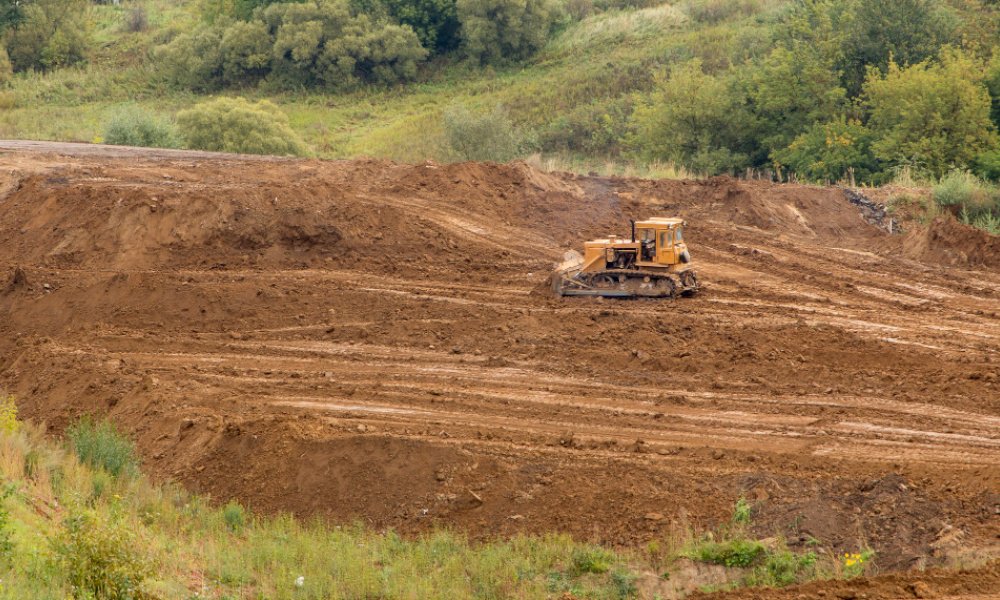
We coordinate qualified trade partners for earthwork with scrapers, dozers, graders, compactors, water trucks and excavators, with GPS machine control for grade accuracy. Machine control lets us hit design elevations without stakes at every pass, and it gives you a record of what was cut and filled.
We pair that equipment with a quality program: density tests by an independent lab, moisture control on every lift, and documentation of subgrade preparation before any stone or concrete goes down. When the pad is done, you receive survey verification of final grades. The earthwork package coordinates stabilized laydown yards with the building pad so material staging does not damage the finished subgrade.
Moisture, wind and haul distances
With a dry climate comes dust, and with open terrain comes wind. We specify water trucks, wind fences and phased stripping so only the area being worked is exposed. Where neighbors or an airfield are close, we restrict operations on high-wind days and monitor.
Moisture conditioning is the other lever. Clay fill needs to be compacted within a moisture range near optimum, and in dry weather that means adding water in controlled amounts and mixing it in. After rain, it means waiting or drying. We plan float time into the calendar for both, and we do not hide that in a general contingency. Sites in Strasburg and Byers are good examples of how distance from supply and open exposure change an earthwork plan.
Heavy equipment, tight discipline
Earthwork brings large machines and many moving parts. We run a traffic plan with designated routes, spotters at blind spots, and a speed limit enforced on site. Operators are trained and equipment is inspected daily. Utility locates are verified before digging, and potholing confirms the depth of existing lines.
Erosion and sediment control is both a safety and a compliance topic. We install perimeter controls, track-out pads and inlet protection before disturbing soil, inspect them after storms and repair promptly. For data-center and technology sites where schedules are tight and neighbors are watching, see how grading supports data center campuses, and how it connects to a flex light-industrial pad.
Start with the dirt, get it right
Send us your site plan and any geotechnical report. We will return a grading strategy with a cut and fill balance, a schedule and a budget range. For what happens next on the site, see stormwater detention and drainage.
Questions Owners Ask
How long does mass grading take on a typical industrial site?
It depends on the volume of cut and fill, the weather and the number of machines we put on the job. We estimate production from the quantities and give you a range, then update it weekly based on actual progress. Wet weather can add days, and dry, windy weather can add water-hauling.
What is over-excavation and why might I need it?
On expansive clay we remove the upper layer beneath the building pad and replace it with engineered fill, so the slab bears on stable material. The geotechnical report sets the depth. It adds earthwork cost but reduces risk of heave and cracked floors.
Do you balance cut and fill on site?
We try to. The goal is to use all cut material within the project and avoid hauling in or out. If a site is out of balance, we show the cost of import or export and look for the cheapest solution, such as adjusting pad elevation slightly.
How do you control dust and runoff?
Water trucks, phased clearing, stabilized entrances and perimeter controls. We inspect after every storm and keep logs for the permit authority. Wind days sometimes require pausing the work.
What do you need to start?
A site plan, topographic survey, geotechnical report, grading permit and utility locates. If any are missing, we help you get them. We prefer to walk the site before finalizing the earthwork bid.
Related
Related Services
Related Building Types
Related Service Areas
Ready to talk about your project?
Request a Project Review