A wind turbine blade does not turn corners the way a tractor-trailer does. The two Vestas plants in Brighton, valued at $290 million and listed with 1,350 jobs, ship blades and nacelles that need wide radii, flat grades and pavement that will not rut under a tall load, and that is the standard we hold for any industrial road on this side of the metro, including roads for advanced manufacturing tenants. The route into a plant is part of the plant.
We build access roads for the loads that will use them. That starts with a swept-path drawing of the largest vehicle you expect, includes crane mobilization and the odd equipment delivery, and ends with a pavement section and a drainage plan that match. A road that carries ten loaded semis a day and an occasional 120-ton crane is a different structure from a road that carries cars.
Owners often ask us to build the road before the plant is approved, so the first equipment can arrive. We can do that, in phases, as long as the permitting path for the road is clear and the first section is sized for construction traffic.
What to settle before the road is drawn
Start with the vehicle. Measure the longest and heaviest load, the turning path and the clearance, then add what changes in a future expansion. A turn built for a 53-foot trailer will not pass an oversize haul, and widening it later means moving curbs, inlets and light poles. We draw the turn once, for the biggest case.
Then settle ownership and easements. Many access roads cross a neighbor's parcel, a utility corridor or a drainage easement. Roads that tie into county or city streets need driveway permits, turn lane studies and sight triangles. We start those conversations at the beginning, because a road built on a verbal agreement turns into a delay when the plant is nearly open.
Roads for the rail-served and airport-adjacent east side
Around the Colorado Air and Space Port, Rocky Mountain Rail Park is a 620-acre rail-served industrial park near Manila Road and I-70, next to the Colorado Air and Space Port, with final development plan approval granted by the Adams County commissioners in September 2020. Port Colorado is a 6,500-acre master-planned development along the Union Pacific, mostly north of I-70 between Imboden and Manila Roads. Large rail-served parks like these mean heavier trucks, longer private roads and more transload activity at the gate, which is why our rail spur site improvements work and road design are planned together.
Interchange work is also changing access. The $87 million E-470 interchange at Aurora Highlands Parkway fully opened on June 28, 2024, bringing a 4,000-acre development onto the tollway. When a new ramp opens, the first private road that connects to it becomes the shortest route to the interstate, and the traffic it carries changes. We design for the traffic you will have in five years, not the traffic on opening day.
How we build a road that stays flat
We sequence the work as clearing, subgrade, utilities, base, paving. The utilities step matters most: every sewer, water, fire loop and duct bank that crosses the road is installed and backfilled to compaction before the base goes down. A road cut open for a late utility patch is a road that fails at the patch. We coordinate with the site utilities package so crossings are sleeved for future capacity.
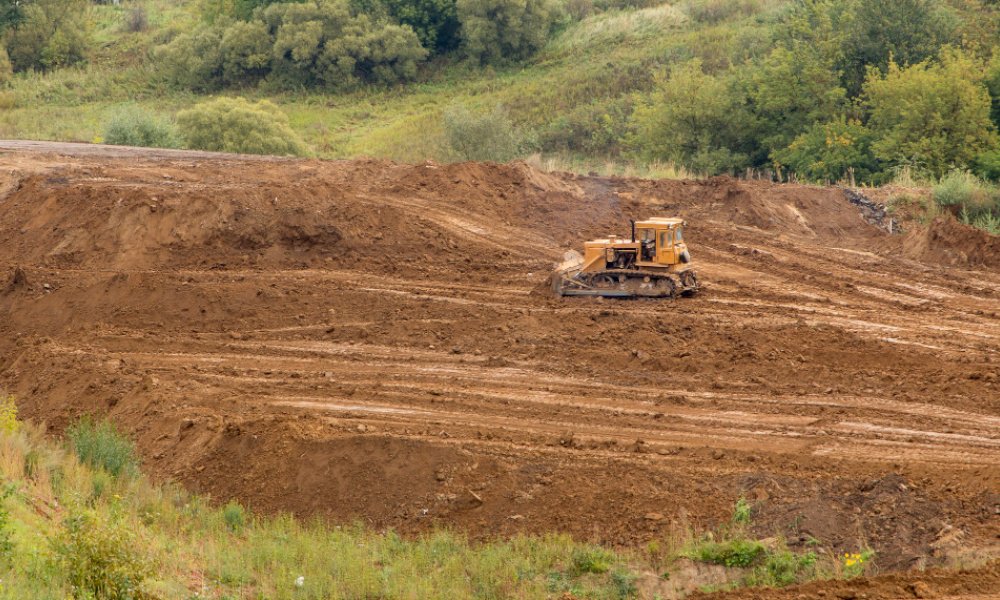
For the pavement itself we use a thick compacted aggregate base, with geogrid or stabilized subgrade where the soil requires it, and a surface chosen for the load. Concrete is common where heavy loads turn or stop, and asphalt is common on straight runs. We form and pour truck aprons and gate zones in concrete so the highest-stress points are the strongest, and we tie the road into the truck court and trailer yard at the building. Our stabilized laydown yards are built to the same base design so the road and the yard share one standard.
Where the money goes
Pavement thickness is the largest variable, followed by subgrade improvement and drainage. A road with a thick aggregate section and a few inches of asphalt costs a fraction of a reinforced concrete road, but it will need more maintenance. We price both and show the maintenance difference over the life of the asset so the choice is made on cost per year.
Utilities and turn lanes are the hidden costs. A public street improvement requirement can double the scope of a driveway, and the dry-utility relocation that comes with it can move the schedule. We price those items separately and early, and we look for ways to share them with neighboring parcels, which is common on the larger parks.
Permits, jurisdictions and review
A private heavy-haul road usually needs a grading permit, a drainage and erosion plan, a street access permit and, in some jurisdictions, a traffic study. Commercial building codes in Colorado are adopted locally, and county and city public works standards govern roads. Aurora and Arapahoe County are on the 2021 I-codes in the Home Builders Association of Metro Denver tracker, while Adams County remains on the 2018 codes while adopting the 2024 codes, so the same plan set can face different standards a few miles apart.
Oversize hauls also need state permits and escorts for public roads. Our job is to make the private part of that route smooth: signed turn plans, protected utilities, and a staging point at the gate. We document the road section, base compaction tests and as-built survey so you can show it to an insurer or a future tenant.
Timing the road with the first heavy delivery
The first heavy delivery sets the road schedule. If a crane or a long-lead machine is arriving in a fixed week, we work backward from that date, build the temporary haul section first, and finish the permanent surface later. This keeps the machine moving and avoids tearing up final pavement. We track the progress with simple weekly dates that your logistics lead can use.
Seasonal weather matters too. Placing asphalt below roughly 40 degrees or on a wet base invites failure, so we plan paving for the warm weeks and use temporary aggregate or concrete through the winter. For manufacturing plants with a firm start-up date, that choice can decide whether the road is ready or not.
Send us the biggest load
Tell us the heaviest and widest piece you will move and the day it arrives. We will return a road section, a turn plan and a schedule.
Questions Owners Ask
How do you design a road for a load that only arrives once?
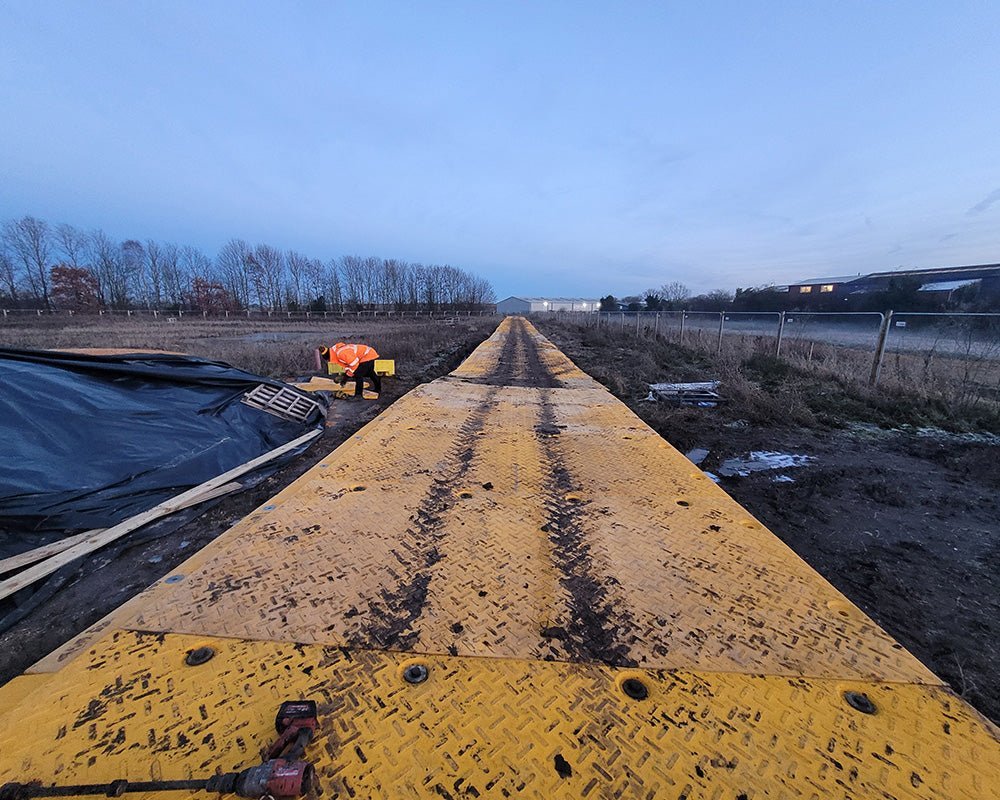
We design the permanent section for the daily traffic and build a temporary reinforced section for the one-time load, such as extra aggregate, steel mats or a thickened concrete pad. That avoids overbuilding the whole road while still protecting buried utilities. Once the load has passed, we remove or reuse the temporary section.
Should a heavy-haul road be asphalt or concrete?
Concrete holds up better where trucks stop, turn or sit, and where wheel loads are concentrated. Asphalt works well on long straight sections and costs less up front. We often use concrete at gates and turns and asphalt on the straight run, and we price both options.
What happens if a utility has to cross the road later?
Cutting a finished road is the fastest way to create a weak spot. We install spare sleeves under the road for future power, data and water, and we mark them on the as-built so the next crew uses them. It costs little during construction and saves a pavement failure later.
Who handles the oversize haul permits?
The carrier normally obtains state and local permits for public roads. We design the private portion to match their route and clear obstacles such as light poles, signs and overhead lines. If the route crosses a public intersection, we coordinate any temporary changes with the jurisdiction.
Can you build the road in phases?
Yes. A common plan is a stabilized haul base first, the permanent pavement second and the final surface after the heavy loads clear. The phasing works only when the drainage and utilities are done in the first phase, so we do them first.
Related
Related Services
Related Building Types
Ready to talk about your project?
Request a Project Review