Gates are where a plant's security plan meets its truck traffic. A card reader set too far from the lane makes a driver climb down. A gate that opens too slowly stacks trucks onto the public road. A camera aimed at the sun gives you nothing at dusk. We build fencing and security as an integrated system, with the civil, electrical and data work done in one coordinated sequence.
East-side owners have a particular reason to care. Buckley Space Force Base lists 3,500 active duty members, 4,000 National Guard and reservists, 2,400 civilians and 2,500 contractors, and the base hosts a National Reconnaissance Office ground station. That level of activity around the corner raises the expectation for what a nearby industrial site looks like and how it controls access, whether you are a neighbor, a supplier or a tenant.
We design from the threat and the traffic, not the catalog. The perimeter protects what is inside, the gate manages who and what enters, and the cameras and sensors give your staff the picture. If any of the three is out of balance, the system is expensive and still leaky. Employee entrances tie into the parking lot layout so badge readers sit where drivers actually stop.
Perimeter, gate, controls and cameras
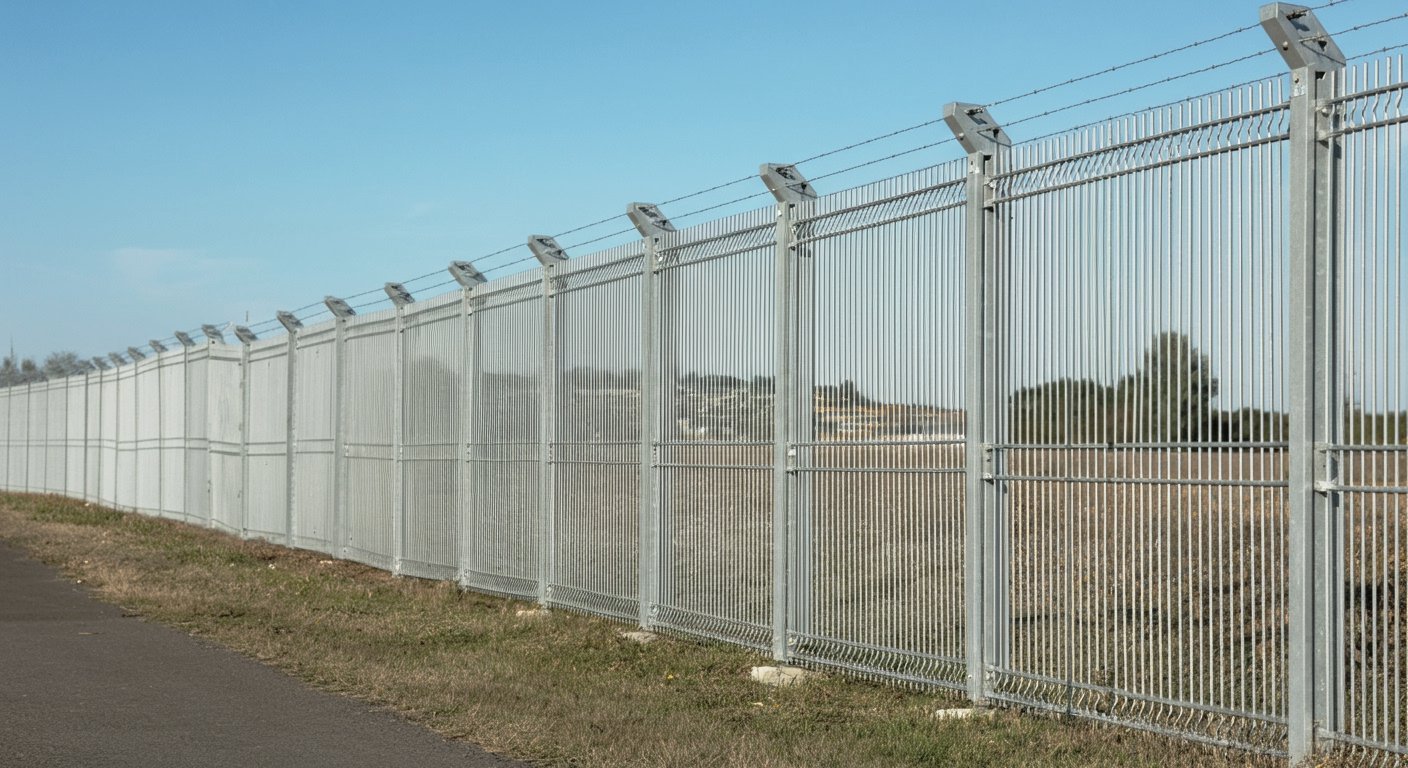
The perimeter is chain link, welded wire, ornamental steel or precast panel, with height, top treatment and footing depth set to your risk. Where wind loads are significant, such as on open prairie sites, we increase post size and footing depth. Gates are cantilever slide or swing, sized to the widest vehicle, with operators rated for the duty cycle of a busy truck gate, which can be hundreds of cycles a day.
Control equipment includes card readers, intercoms, license plate readers, loops and photo-eyes, as well as cameras and video storage. We run the conduit, set the pedestals and pour the pads, then coordinate with your integrator or IT team on equipment and commissioning. When the infrastructure is right, the electronics install cleanly and stay reliable.
Life safety and fire access come first
Fences and gates cannot block fire access. Fire lanes must remain open, gates must have the required emergency access devices, and key boxes or radio-operated overrides must be installed where the fire department requires them. We review the fire marshal's comments before ordering gates, because a gate change after delivery is expensive and a failed fire access inspection holds up the certificate of occupancy.
Worker safety matters too. Gate operators need photo-eyes and edge sensors so a moving gate stops when it meets a person or vehicle. Pedestrian gates need clear sight lines, lighting and a marked path. We also install bollards and guardrail where trucks could hit a pedestrian path, reader pedestal or electrical cabinet.
Security needs on the east side
The Aurora economy is closely tied to the base, which reported about $2.6 billion of economic impact on the surrounding community in 2024 and an estimated 20,072 jobs. Surrounding industrial sites range from simple warehouse yards to facilities that handle sensitive materials, and the fencing and access plan needs to match. We build both ends of that range.
E-470 passes east of the base, with Aurora exits at Quincy Avenue (exit 13) and 6th Parkway (exit 19), and a lot of east-metro industrial ground sits near those exits. Open ground, long frontage and few neighbors mean longer fence lines and fewer natural barriers. That raises the cost per foot of fence and the value of good design, since a single weak point can open the whole line.
Pieces that make the perimeter work
Fencing depends on adjacent work. Lighting turns the perimeter from a line into a visible boundary, so we coordinate with yard lighting and electrical site work to share poles and trenches. Paving at the gate has to support heavy loads and drain correctly, which links the gate to the truck court and trailer yard it serves.
If you are building a data center or a plant that handles regulated materials, the fence is part of a layered system, with controlled vestibules, vehicle barriers and more detailed monitoring. We can build the civil portion and coordinate with your security consultant. For owners in pharmaceutical and life sciences the access control and audit trail are as important as the fence.
Getting the gate in before the first truck
Fencing is among the first things we build, since a fenced site protects stored materials and equipment. We install temporary fencing at mobilization, then the permanent perimeter after the grading is complete and before landscaping. Gate operators, conduit and loops go in with the paving. We hold the electronics until the building is closer to completion to avoid damage.
Lead times matter. Custom gates, operators and access hardware can take weeks to arrive, so we order after the plans are approved and sequence installation to match. A stabilized laydown yard often uses a temporary gate that is later replaced, and we plan the location so the permanent gate can sit where the temporary one stood.
Plan the gate with the truck court
Share your site plan and the number of trucks per hour at peak. We will propose a gate layout, a fence line and a conduit plan.
Questions Owners Ask
How far back from the road should a truck gate sit?
Far enough that the longest vehicle you expect can stop completely off the public road while the gate opens. For a tractor with a 53-foot trailer, that usually means a stacking lane considerably longer than one truck. We size it from your peak arrival rate and the time it takes to verify each vehicle.
What fence height is typical for an industrial yard?
Six to eight feet is common for general security, with barbed or similar top treatment where the jurisdiction and the owner allow it. Higher-risk sites go taller or add multiple layers. Local zoning sometimes limits height or materials near a street frontage, which we check first.
Who handles the electronics, you or my integrator?
Either. We can build the conduit, power, pads and pedestals and leave the electronics to your integrator, or we can coordinate a turnkey installation with a qualified partner. The infrastructure is the same in both cases, and it has to be right before the equipment goes in.
Can the fence follow a drainage swale or a slope?
Yes, with the right details. We use stepped panels, racked panels or custom grading, and install grates or culverts at drainage crossings so water flows and the fence stays secure. Slopes and swales are where perimeters often fail, so we plan them carefully.
How much of the system should be installed before the building is done?
The perimeter, gate foundations and conduit should be in early. The electronic equipment is usually installed late to avoid damage and to match the building schedule. This sequence also lets you operate with a basic gate while the building is under construction.
Related
Related Services
Related Building Types
Ready to talk about your project?
Request a Project Review