A 191-foot control tower at the Colorado Air and Space Port is a reminder that a large share of east-side industrial ground sits under, beside or near an approach path. A pole that is a few feet too tall or a fixture aimed a few degrees too high is not just a neighbor complaint. It can be a review issue. We design and build yard lighting and the electrical that feeds it with that in mind.
The work is more than poles. We install the service pathway, the duct bank, the pull boxes, the pole foundations and the controls that tie the whole system to your gate and your shift schedule. We pick fixtures with sharp cutoff so light lands on the truck court and not in the pilot's eyes, and we confirm the photometrics before ordering a single pole.
A well-lit yard makes your operation safer at 3 a.m., speeds trailer checks and lets night crews work without hand lights, and it is what makes a truck court and trailer yard usable after dark. We build it so it keeps working, with spare conduit for the next camera, charger or sensor, and with the gate and perimeter wiring shared with our fencing and security integration work.
Lighting designed from the trailer outward
We start with a photometric plan built from your layout: dock doors, trailer stalls, drive aisles, gates and walkways. Each zone gets a target level, and we choose pole heights and fixture optics to reach it with the fewest poles. Fewer poles mean fewer foundations, less trenching and less glare. LED fixtures with full cutoff and a defined color temperature are our baseline, with dimming schedules when the operation is quiet.
For sites near the airport, near Buckley Space Force Base, where the Colorado Air National Guard's 140th Wing flies F-16C Fighting Falcons, and Centennial Airport, which recorded 360,725 aircraft operations in 2023, we ask early whether the site falls into a height or lighting review. If it does, the design is done with that constraint in hand, not retrofitted after the poles are up.
The electrical behind the light
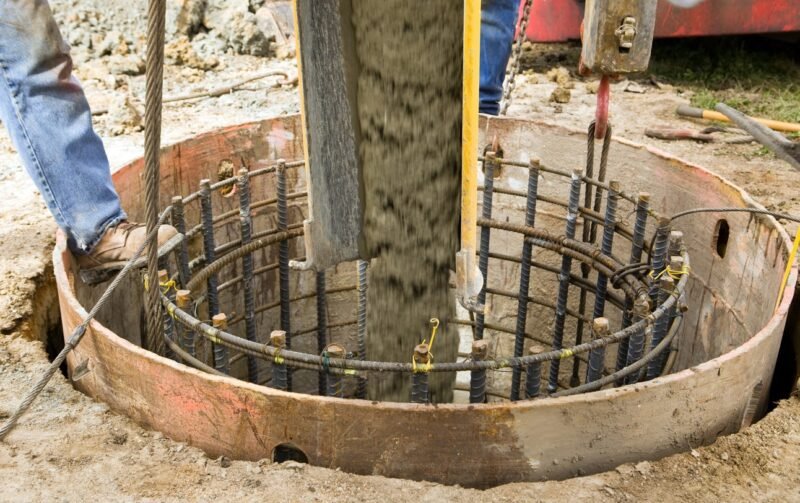
We install primary and secondary conduit, pull boxes and pole bases, and we pour or drill the foundations for poles in soil conditions that vary across the metro. A pole base in dry, firm soil and one in saturated clay are not the same structure, so we size the shaft to the soil report and the wind load. Wiring is done in conduit sized with room for growth, with separate runs for lighting, security and data where that makes sense.
The scope also includes site power for gates, operators, card readers, trailer-tracking antennas, EV chargers and fuel islands, plus the controls that run it. For larger sites we coordinate with the electrical duct bank and underground work to keep trenches shared, so one excavation serves lighting, power and communications.
Code, inspection and the utility
The City of Aurora's Public Works Building Division lists the 2021 International Building Code with the 2023 National Electrical Code and City of Aurora amendments. Electrical editions are set at the state level while building codes are adopted locally, so the permit you pull in one jurisdiction may call for a different edition than a neighboring one. We confirm the editions that govern your parcel and design to those.
Service availability is a schedule item. We start the utility application as soon as the load is known, because transformer lead times and service extension agreements can run longer than the construction of the yard. We coordinate meter locations, easements and switchgear pads in advance so the permanent power arrives when the building is ready to turn on.
Choices that affect operating cost
The biggest choice is control strategy. A yard that dims to a low level when no one is working and rises to full output when a truck or person is detected uses a fraction of the energy of a fixed system. We also choose pole spacing and mounting heights to avoid light bleed onto adjacent parcels, a common point in site-plan review.
The second choice is resilience. Hail is a real risk in Colorado, and exposed fixtures, camera domes and solar panels need to be specified for it. Division of Insurance data cited by CBS Colorado puts the state second in the nation for hail insurance claims, so a lighting system should expect some impact. We specify tough lenses, accessible junction points and a replacement plan that does not close the yard.
Operators who light their yards hardest
Logistics and distribution operators run trailers around the clock, and their yard lighting has to support safe backing and fast trailer checks. E-commerce fulfillment sites add shift change foot traffic across parking lots, which is why we link the lot design with the lighting plan from the start.
Aviation and aerospace users have their own rules. A hangar apron, a ramp and a security perimeter each need a different lighting approach, and we build with the owner's engineers when those standards apply to a hangar project. The same discipline of verifying heights and aiming applies to every other site we light.
Fitting lighting into the paving sequence
Lighting touches nearly every other trade in the yard. Conduit goes in before base stone. Pole bases go in before paving. Poles and fixtures go up after final grades, and aiming and commissioning take place at night. We set that order in the schedule, and we order poles and fixtures early because lead times can slip behind the pavement.
If a stabilized parking lot or truck court is already built, we can trench in sections and patch with matching surface. That costs more than doing it in sequence, so we encourage owners to bring us in before final paving whenever possible.
Light the yard before you pave it
Give us the site plan and the nearest airport or flight path. We will return a photometric layout, a power plan and a conduit map before paving starts.
Questions Owners Ask
How tall can the poles be near an airport?
It depends on the distance from the runway and the airport zoning, and the answer comes from a height review rather than a rule of thumb. We ask the owner and the local airport sponsor early. If the site is in a restricted zone, we use shorter poles with tighter optics or wall-mounted fixtures.
How much light does a truck court need?
It depends on the activity. Dock doors, trailer inspection lanes and gate entries need higher levels than storage rows or perimeter drives. We set target levels for each zone from the lighting standard you follow and test with a photometric plan before the order is placed.
Can you add lighting to an existing yard?
Yes, but it costs more because we have to trench through finished pavement or work in sections. We can reduce the damage by using existing conduit, wall-mounted fixtures or poles on existing bases. We will survey the yard and tell you which path is the cheapest.
How do you handle power to gates and cameras?
We run separate circuits and conduit for security equipment so a lighting outage does not disable access control. Spare conduits are included for future cameras, readers and tracking equipment. Our fencing and security team coordinates the locations.
What causes lighting systems to fail early?
Water in junction boxes, poor grounding and fixtures not rated for the weather. Hail and wind also take a toll. We specify sealed boxes, proper grounding, rated fixtures and accessible service points.
Related
Related Services
Related Building Types
Related Industries
Related Service Areas
Ready to talk about your project?
Request a Project Review